Showing posts with label Discussion group. Show all posts

Saturday, July 7, 2012

Uranium Mining and Fracking in Australia

This month's discussion group will look at uranium mining and fracking in Australia. For those who can't make the discussion, there are some overviews below. Feel free to add comments if you have questions or opinions to share.

Uranium Mining in Australia
There have been three main bursts of uranium mining exploration in Australia. The first was in the mid-1940s and 1950s, after pressure from the US and UK governments encouraged the federal government to offer tax concessions. The second came in the late 1960s as nuclear power began to take off, and the third has happened since 2002 (driven, in part, by claims that nuclear power will help to provide an energy source with a lower impact on climate change than coal).

an image of a minesite, fenced off, with a 'controlled area' sign in front of it
Photo courtesy of Alberto OG on Flickr

Opposition to uranium mining has accompanied these developments, with activists concerned about the environmental impacts, the impacts on Aboriginal communities and lands, and the links between uranium mining and nuclear weapons.


The Wikipedia entries on uranium mining in Australia and the anti-nuclear movement in Australia both provide useful overviews.

This interactive map provides a useful overview of previous, current, and proposed nuclear sites, covering processing facilities and waste storage sites as well as military and mine sites.

The RoxStop website offers some suggestions on how to take action on uranium mining in Australia, including signing petitions and shifting your super away from funds that invest in uranium mining.

The Lizard's Revenge website provides information on the upcoming attempt to highlight the problems with the expansion of Olympic Dam.

For people in Western Australia, the Conservation Council of Western Australia has provided an overview of the problems with the proposed Toro Energy mine at Wiluna.

Fracking in Australia
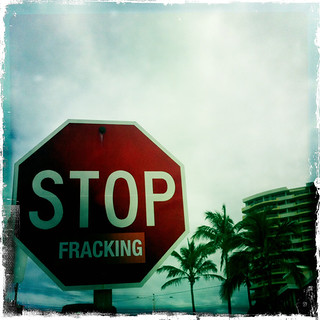
Photo from Darth Ambiguous on Flickr
Fracking is a relatively recent development in Australia: the technology has only become feasible over the last decade or so, and while it has been used quite extensively elsewhere Australia has seen the most rapid expansion of fracking since 2010. Fracking involves using pressurised fluid mixed with sand and a range of chemicals to fracture gas reservoirs so that the gas can be accessed. There are a number of concerns about this technology, including the environmental impacts and the impacts on farmers. 

This article in The Economist, Gas Goes Boom, looks at the development of fracking in Australia, as well as some of the concerns about the environment and effects on farmers.

Dennis Cooke's Explainer: coal seam gas, shale gas, and fracking in Australia on The Conversation is also a good starting-point for those wanting to find out more.

For more on opposition to fracking in Australia, you can visit:
and

Friday, August 19, 2011

Discussion Group Summary: Carbon Tax

Our recent discussion on the carbon tax began with an overview of the tax's development, how it's structured, and some of the responses to it.

Political context
The price on carbon is, in large part, an outcome of the current Australian minority government. Before Julia Gillard was elected she promised that she wouldn't implement a carbon tax, and would instead engage in a long period of community consultation before deciding on a course of action. The necessity of negotiating with the Greens and independents, however, shifted that plan. This is not to say that it's the Greens' plan - it's a step in the direction they want, but is far from what they would ideally like. Rural independents Rob Oakeshott and Tony Windsor have also played a role in shaping the tax, particularly by pushing for petrol to be exempted. The package is also the result of a months-long consultation process with affected industries and other groups.

Australian emissions
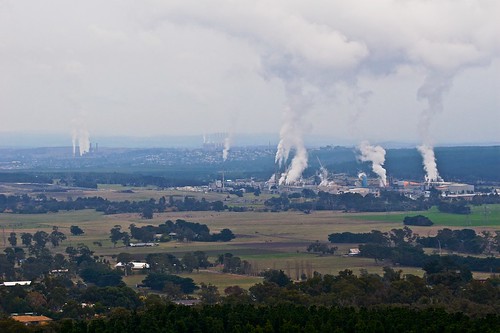
Another important aspect of the tax's background is Australia's carbon emissions: Australia produces more pollution per person than any other country. This is partly because Australia tends to have significantly lower levels of energy efficiency than other developed nation (in 2004, “the overall carbon efficiency of the economy, per unit of fossil fuel used, [was] about half that for Europe and Japan.” This is related, but not entirely due, to Australia's heavy dependence on coal for energy.
Photo courtesy of Flickr user yewenyi.

The structure of the plan
The details of the plan are outlined at the Clean Energy Future site. The carbon tax is currently aimed at a five percent reduction in greenhouse gas emissions by 2020, and should cover about 60% of Australia's emissions. It focuses on the 500 largest polluters (excluding the agricultural sector), with assistance packages for some industries (such as steel manufacturing). There's also significant funding included for the development of 'clean' and renewable energy, energy efficiency, and biodiversity conservation. After three years, there will be a shift to an emissions trading scheme, with a cap on carbon and a minimum price of $15 a tonne.

A significant component of the package is assistance to Australian households. Treasury modelling indicates that living costs are expected to rise by expected to rise by 0.7% in 2012-2013 (compared to the 2.5% increase associated with the GST, and the 2.9% associated with inflation). Nine in ten households will receive some money to cover this cost, with approximately two thirds of Australian households receiving enough money to cover it completely. Much of this will be provided by raising the minimum income threshold for taxation and giving tax cuts to those earning under $80,000 a year (following the recommendations of the Henry Tax Review). There will also be increases to allowances, pensions, and family payments. 

Responses
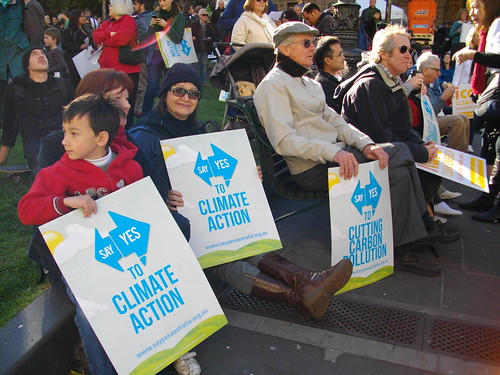
Despite the limited reach of the carbon tax, opposition to it has been fierce. Much of the opposition has been lead by the Liberal party, industry groups which have launched a $10 million campaign against the tax, talkback radio, and reporting in newspapers such as the Daily Telegraph. This has been instrumental in the drop in support for the government: in July, Labor party's primary vote dropped to 26 percent, the lowest for a major party in the poll's 39-year history. There are a number of groups, including SayYes and GetUp, trying to build support for the tax, and more generally for effective climate action, but they have an uphill battle ahead.
Photo courtesy of Flickr user Alex Schlotzer

This is a very brief overview of a complex issue. If you want to read more, one way to start is the sites I've bookmarked here - the information for this post comes from these sites.

You're also very welcome to ask questions or add comments on this post. During the discussion, we were mostly trying to understand how the tax will create change, who will be effected, and the reasons for the opposition to the tax (including opposition from those who will benefit most from the associated changes to tax and allowances). What do you think?

Saturday, July 23, 2011

Discussion Group: Carbon Tax

In February this year the Australian government announced a tax on carbon pollution, to come into effect in July 2011. The tax will be levied on a limited number of companies, and will be replaced by a cap and trade system in around three to five years. The tax has proved to be controversial, with demonstrations both in favour and against it.

We'll talk through some of the issues surrounding the carbon tax, including how it will work, it's potential effect on households and the economy, and how the tax has been covered in the media.

If you'd like to do some reading before you come along, here are some resources:
* The ABC has a number of infographics that show key figures, effects on food prices, how carbon pricing works, which areas emissions will be cut from, effects on income and the economyAustralia's current emission levels, and a short overview of different approaches to cutting emissions.
* The Australian government has released a site that will allow you to estimate the effects on your household. Why not try it out?
* The Drum's Ben Eltham takes a closer look at the main alternative being proposed: the Coalition's Direct Action Plan.
* In the wake of the government's announcement, different groups are trying to shape how Australians react: a new industry lobby group has been formed to oppose the tax, Crikey's Andrew Crook claims that the Daily Telegraph's coverage is biased, and GetUp! is trying to crowd source funding for their own ads.

Of course, you're also very welcome to show up without reading these resources, or to do reading of your own.

Meet us at the Moon Cafe at 5pm, Sunday 14th August. You can RSVP through the Facebook event page or just come along.

Tuesday, March 15, 2011

The rise of corporate lobbying

We covered a range of topics at the discussion group on Sunday, including the possibility of a no-fly zone in Libya and its implications, and the likelihood of genuine political reform in the Middle East. This conversation led us to examining democracy as we know it, and reflecting on the rise of corporate lobbying. Vanessa Baird at the New Internationalist highlights the implications of the ever-cosier relationship between big business and politicians, such as McDonalds and PepsiCo now contributing to writing the UK National Health Policy, and the Americans for Prosperity Foundation, founded by David Koch of Koch Energy Industries, training Tea Party activists.

The influence that corporate lobbyists wield in politics, largely as a result of the ‘revolving door’ which enables people to move quickly from roles in government to lobbying positions in corporations, creates compelling reasons for the formal participation of social movements in the political process. It also highlights the need for transparency, such as a mandatory register of all lobbyists that detail who they are lobbying, how much they spend on it, and details of which politicians they meet with and how often. ‘Democracy 4 Sale,’ which was founded by the Greens NSW, provides some details of the Australian situation.

Sunday, February 13, 2011

What will the Egyptian uprising mean for women's rights?

As Michelle wrote in the comments on the previous post, our discussion last night turned up some surprising facts: Liza pointed out that over 90% of Egyptian women are "circumcised" (or rather, have experienced female genital mutilation)*. This seemed very strange to me, because I had the impression that there had been strong women's movements in Egypt, and I assumed that FGM would be the kind of thing that women's movements would oppose.

Having looked around a little, it turns out that Egypt does have a history of important activism by women, including opposition to FGM. Nadje S. Al-Ali's The Women's Movement in Egypt, with Selected References to Turkey and Nadia Wassef and Nemat Guenena's Unfulfilled Promises: Women's Rights in Egypt both give good overviews of women's activism and key issues.

It's also important to note that this history of women's activism has had some significant results. For example, women's representation in parliament is guaranteed throughthe provision of a minimum number of seats, and women have a significant presence in Egyptian higher education.

At first media coverage of the recent Egyptian protests included very few images of women (Opinioness of the World gives a good overview of this, with plenty of useful links, and a number of news sources have noted that women have been present in significant numbers at the protests (see, for example, Lindsey's article on PRI and Topol's article on Slate).

I'm curious to see what happens over the next few months in Egypt. After last night's discussion, I'll be paying special attention to whether women's concerns are addressed (or even raised) at any stage during the elections and negotiations.

------
* Nadia Wassef, an activist against FGM, discusses why she uses the term "female circumcision" rather than FGM in this article. It's worth a read.