Showing posts with label ethical consumerism. Show all posts

Saturday, August 11, 2012

Fairtrade product search

From Fairtrade Australia New Zealand


Click on Find Fairtrade on the Fairtrade Australia New Zealand website to use a great new product search function. Type in a product type, location or simply browse the many brands of Fairtrade Certified products available. Generated by Fairly Local, you too can contribute to the database by submitting locations where you have seen Fairtrade Certified products - read more here on how to contribute.

Friday, October 15, 2010

Lifecycles Workshop #3: Electronics


Wednesday, 10 November 6:30pm-8:30pm

The Edmund Rice Institute for Social Justice
24 High St, Fremantle

Entry by donation.

The Bluestocking Institute's Lifecycles workshops focus on helping participants to develop action plans around the issues that they care about.

Speakers at Lifecycles: Electronics will discuss the environmental and social costs of producing electronic goods, ways to prolong their usefulness, and how to recycle them ethically. There will also be time for you to ask questions and share your own experiences and knowledge.

You are invited to bring old mobile phones that you wish to recycle.

For more information or to RSVP:
• visit the Facebook event page at http://is.gd/g2BSZ or
• email us at bluestocking@bluestockinginstitute.org or
• call Sky on 0411 595 834.

Sponsored by The Bluestocking Institute for Global Peace and Justice

Thursday, May 20, 2010

Lifecycles Workshop: Food


Sign up now for the first Lifecycles workshop. Details below.

16 June 6:30pm-8:30pm

The Edmund Rice Institute for Social Justice
24 High St, Fremantle

The Bluestocking Institute's Lifecycles workshops help participants develop action plans around the issues that they care about. The emphasis for Lifecycles: Food will be on building a fairer, healthier, and more sustainable food system through actions that we can take in our own lives and communities.

Speakers at Lifecycles: Food will discuss different aspects of food production and consumption, including how and where food is grown, fair trade, and animal rights. There will also be time for participants to share their own experiences and knowledge.

For more information or to RSVP:
• visit the Facebook event page or
• email us at bluestocking@bluestockinginstitute.org or
• call Sky on 0411 595 834.

Suggested donation $5

Wednesday, April 21, 2010

Ethical Grocery Shopping

Sometimes it can be mystifying trying to make the right choices when grocery shopping. I find myself staring at a wall of biscuits, or oil, or toothpaste, try to weigh up the issues. Buy local? How much packaging does each product have? Has the company that produces it done anything particularly odious? Is the company owned by another umbrella company (probably)? How far can I stretch my budget to make a more ethical choice?

Ethical shopping guides can be a useful shorthand to help you with these choices. The Ethical Consumer Guide, for example, offers not only a printed guide but also an iPhone app, supermarket tours (in Melbourne), and some principles to guide your choices.

The Good Grocery Guide is also useful, and is Perth-based. As well as providing an ethical product list, it also offers more general ethical shopping tips.

Shopping guides have their limits. As the Ethical Consumer Guide points out, in many cases it's best to think carefully about whether you really need to buy the product at all: "About 80% of all saleable products end up as waste, on average, within just 6 months."

Friday, December 18, 2009

Ethical gifts at the last minute

by Shae

I love the idea of making beautiful, handcrafted items for friends and family for Christmas and birthdays, I just don’t seem to get around to it. A few days before the event, I start hatching a plan that requires time and skills that are in short supply. Instead I look for things that other people have made that I can quickly send to friends and family in the US and Australia. Here are a couple of my favorite gift ideas that also support worthwhile projects.

Donation gifts

Many non-profit organisations these days have an option for you to buy donations. Oxfam Unwrapped lets you ‘purchase’ a gift, such as a cow, for your grandmother, who then receives a card (not the cow) indicating the donation made in her honour. The purchase helps support Oxfam’s advocacy and international development work.

Fair trade

Numerous websites and shops carry fair trade goods that are designed to provide income directly to the producers, bypassing middlemen. For example, check out U-Chus and Global Exchange. A few fair trade companies aim to provide fashionable, designer products that are also environmentally-friendly and made under ethical conditions. See People Tree and Indigenous Designs. If there's a particular product you want to get someone, like a pair of shoes or some clothing or a bag, you could also try searching online for that product and 'fair trade' - there are lots of great online stores out there.

Union-made

The International Labor Rights Forum compiled a list of clothing and footwear manufacturers that are unionized or worker cooperatives in its Shop with a Conscience Guide. For a list of companies that have signed the Homeworkers Code of Practice in Australia, see this site. By signing the code, the company indicates its commitment to meeting standards for homeworkers that produce their goods in Australia.

Other ideas

There are also plenty of other gifts you can give that won't put a burden on the planet and will help support the workers who make them. You can give tickets to community events or concerts, handmade and hand-crafted gifts from Etsy, and locally-made gifts from markets like Unwrapped (on Dec 19th) Made on the Left and Perth Upmarket. There's also a Christmas Organic Growers Market on Wednesday 23rd at City Farm, which will have plenty of great last-minute gifts.

Whenever possible donate, recycle, upcycle, and support workers’ initiatives locally and globally. That way as well as giving gifts to your friends and family, you're also helping to make a better world.

Do you have other advice for last-minute ethical gifts? We'd love to hear your ideas and comments!

Wednesday, December 16, 2009

Celebrating Christmas Ethically: Do It Yourself

Christmas is a special challenge for those who are trying to live ethically. It's one thing to cut down on consumption in your own life, but quite another to skimp on others. I'm usually a fairly frugal and environmentally-conscious person (although of course there are glaring holes in my lifestyle, as with anyone). I mend my clothes, darn my socks, try to get my electronics second-hand, and generally try to think hard about any purchases that I make.

So when it comes to Christmas I always start with good intentions. But then, somehow, things get out of hand. It's hard to be frugal when it comes to the people that I love, and all my stern lectures to myself about the problems with showing love through Stuff tend to fade away as I find myself stepping out to brave the Christmas crowds.

I've been getting better: these days most of my presents come from Oxfam or other Fair Trade stores. There are some great options for buying presents ethically, which Shae's going to blog about soon.

I'm trying to be adventurous this year, though, and make as many presents as I can using recycled materials from around the house. I've been trawling the Internet for ideas that aren't too difficult and don't require that you go out and buy a heap of supplies. Here are a few:

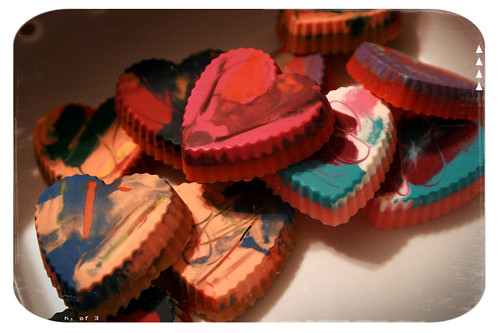
CraftZine has some good ideas, including this run-down of a few of their easy projects. I especially liked the kids' crayon and sketchbook kit, because I think melted crayons are beautiful (image by wonderfully complex).

I also spent quite a while looking around Craft Bits: I rather like the mix-of-something-in-a-jar recipes and a few of the recycled craft ideas. If you've got a stack of old records sitting around the recycled vinyl rings and bangles might solve two problems at once.

One DIY project that I've tried out on previous Christmases is making origami boxes. There are plenty of instructions online, including on eHow and WonderHowTo. Last year I got a heap of old picture books from an op-shop and used the pages to make the boxes. You can fill the boxes with biscuits (I recommend spice cookies), handmade notebooks, re-melted crayons, or other treats (image from oschene).

If, like me, you enjoying fixing things, you might want to consider giving a coupon book. You can make coupons for servicing bicycles, darning socks, sewing on buttons, and the other little tasks that keep your things going for longer. Or for meals cooked, back massages, house-tidying, computer servicing, or whatever you can do and are happy to share. There are templates for coupon-books online, including on eHow. If you just happen to have a whole cupboard of paper scraps (luckily, I do!), you could use them to make a coupon book.

There are also some great recipes online for pickles and preserves. I'm rather partial to kimchi, and also quite like the look of Greek spoon sweets, although I'm not sure that my skills in the kitchen are up to producing edible versions of either!

Not everyone has time to make presents, but the DIY option is great if you do have the time and want to avoid the Christmas rush. It can also help make Christmas less of a burden on the environment, especially if you try to reuse and recycle rather than buying supplies new.

Saturday, August 15, 2009

Ethical school uniforms

Ever wondered who makes school uniforms or the conditions under which those uniforms are made?

FairWear reports that school uniforms are made by some companies in Australia who are accredited to the Homeworkers Code of Practice and have had their supply chain checked for compliance to wage and occupational health and safety requirements, others are made in factories who are not accredited and have not been monitored, while others are made in sweatshops or by homeworkers for very low rates of pay, and without the legal entitlements such as superannuation and holiday pay.

FairWear is gathering information about the working conditions under which school uniforms are produced. If you are a student, parent or teacher, send the following details to fairwear@awatw.org.au : school name, number of students, item of clothing, brand, where it was made, where it was bought and price (optional).

This information will help FairWear get more Australian manufacturers accredited to the Homeworkers Code of Practice, and get more schools choosing to source their uniforms from accredited companies wherever possible.

Saturday, February 7, 2009

Is it possible to be an ethical consumer?

The consumption habits of many of us in the global North and among elites in the global South are obviously unsustainable. The raw materials needed to support our habits are unreasonable and unfair. As standards of living improve in countries like China the demand for goods continue to grow, putting additional demand on people and the planet.

Economists tell us that consumption is good. Economic growth is the answer to all of our problems. After all, they tell us, purchasing things means that someone has a job making things. In 2001, President Bush tried to convince the American people that consumption was their patriotic duty following the attacks on September 11. He encouraged everyone to show those terrorists what we are made of and go out there and shop. And they did.

Fast forward to 2009 and the call to consume seems absurd (as it did to many people then) and potentially criminal in the light of the financial tsunami, which originated in the US but has now hit millions of people around the world, leaving a trail of foreclosures, bankruptcies, and poverty in its wake.

So what is the relationship between consumption and political action? While I don’t accept the premise that indiscriminant consumption is the answer to fixing the global financial system, I do believe that there is potential to use our purchasing habits to further our political goals. For example, there are worker-owned cooperatives, fair trade producers, and unionized factories that provide decent livelihoods for thousands of women and men.

I should be clear that I don’t think consumption is sufficient as the only point of political action, but rather it is one small, but albeit important, piece of broader civic action. Although I am writing this from a perspective of relative privilege, the same is true for consumers in the developing world. Choices we all make -- individually and collectively -- can be used as valuable tools to influence the way systems are structured and resources are distributed.

If you happen to be living in one of the countries that recently passed economic stimulus packages and you receive money, I encourage you to think about how to spend that money in a way that furthers your social and political values. Give it away, save it, or if you spend it, check out this guide to where to buy ethically made goods: Shop with a Conscious Consumer Guide