Friday, December 18, 2009

Ethical gifts at the last minute

by Shae

I love the idea of making beautiful, handcrafted items for friends and family for Christmas and birthdays, I just don’t seem to get around to it. A few days before the event, I start hatching a plan that requires time and skills that are in short supply. Instead I look for things that other people have made that I can quickly send to friends and family in the US and Australia. Here are a couple of my favorite gift ideas that also support worthwhile projects.

Donation gifts

Many non-profit organisations these days have an option for you to buy donations. Oxfam Unwrapped lets you ‘purchase’ a gift, such as a cow, for your grandmother, who then receives a card (not the cow) indicating the donation made in her honour. The purchase helps support Oxfam’s advocacy and international development work.

Fair trade
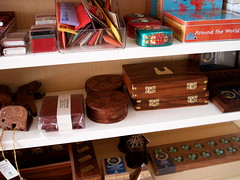
Numerous websites and shops carry fair trade goods that are designed to provide income directly to the producers, bypassing middlemen. For example, check out U-Chus and Global Exchange. A few fair trade companies aim to provide fashionable, designer products that are also environmentally-friendly and made under ethical conditions. See People Tree and Indigenous Designs. If there's a particular product you want to get someone, like a pair of shoes or some clothing or a bag, you could also try searching online for that product and 'fair trade' - there are lots of great online stores out there.

Union-made

The International Labor Rights Forum compiled a list of clothing and footwear manufacturers that are unionized or worker cooperatives in its Shop with a Conscience Guide. For a list of companies that have signed the Homeworkers Code of Practice in Australia, see this site. By signing the code, the company indicates its commitment to meeting standards for homeworkers that produce their goods in Australia.

Other ideas

There are also plenty of other gifts you can give that won't put a burden on the planet and will help support the workers who make them. You can give tickets to community events or concerts, handmade and hand-crafted gifts from Etsy, and locally-made gifts from markets like Unwrapped (on Dec 19th) Made on the Left and Perth Upmarket. There's also a Christmas Organic Growers Market on Wednesday 23rd at City Farm, which will have plenty of great last-minute gifts.

Whenever possible donate, recycle, upcycle, and support workers’ initiatives locally and globally. That way as well as giving gifts to your friends and family, you're also helping to make a better world.

Do you have other advice for last-minute ethical gifts? We'd love to hear your ideas and comments!


Wednesday, December 16, 2009

Celebrating Christmas Ethically: Do It Yourself

Christmas is a special challenge for those who are trying to live ethically. It's one thing to cut down on consumption in your own life, but quite another to skimp on others. I'm usually a fairly frugal and environmentally-conscious person (although of course there are glaring holes in my lifestyle, as with anyone). I mend my clothes, darn my socks, try to get my electronics second-hand, and generally try to think hard about any purchases that I make.

So when it comes to Christmas I always start with good intentions. But then, somehow, things get out of hand. It's hard to be frugal when it comes to the people that I love, and all my stern lectures to myself about the problems with showing love through Stuff tend to fade away as I find myself stepping out to brave the Christmas crowds.

I've been getting better: these days most of my presents come from Oxfam or other Fair Trade stores. There are some great options for buying presents ethically, which Shae's going to blog about soon.

I'm trying to be adventurous this year, though, and make as many presents as I can using recycled materials from around the house. I've been trawling the Internet for ideas that aren't too difficult and don't require that you go out and buy a heap of supplies. Here are a few:

CraftZine has some good ideas, including this run-down of a few of their easy projects. I especially liked the kids' crayon and sketchbook kit, because I think melted crayons are beautiful (image by wonderfully complex).

I also spent quite a while looking around Craft Bits: I rather like the mix-of-something-in-a-jar recipes and a few of the recycled craft ideas. If you've got a stack of old records sitting around the recycled vinyl rings and bangles might solve two problems at once.

One DIY project that I've tried out on previous Christmases is making origami boxes. There are plenty of instructions online, including on eHow and WonderHowTo. Last year I got a heap of old picture books from an op-shop and used the pages to make the boxes. You can fill the boxes with biscuits (I recommend spice cookies), handmade notebooks, re-melted crayons, or other treats (image from oschene).

If, like me, you enjoying fixing things, you might want to consider giving a coupon book. You can make coupons for servicing bicycles, darning socks, sewing on buttons, and the other little tasks that keep your things going for longer. Or for meals cooked, back massages, house-tidying, computer servicing, or whatever you can do and are happy to share. There are templates for coupon-books online, including on eHow. If you just happen to have a whole cupboard of paper scraps (luckily, I do!), you could use them to make a coupon book.

There are also some great recipes online for pickles and preserves. I'm rather partial to kimchi, and also quite like the look of Greek spoon sweets, although I'm not sure that my skills in the kitchen are up to producing edible versions of either!

Not everyone has time to make presents, but the DIY option is great if you do have the time and want to avoid the Christmas rush. It can also help make Christmas less of a burden on the environment, especially if you try to reuse and recycle rather than buying supplies new.

Wednesday, October 28, 2009

World Vegan Day Picnic

Those of you who came to (or wanted to come to) the Politics of Food discussion group may want to attend World Vegan Day Picnic:

Tuesday, 13 October 2009 09:58

Join Animal Rights Advocates Inc. for a celebration of vegan food and culture on Sunday 1 November - World Vegan Day!

12-4pm, Sunday 1 November

Sir James Mitchell Park, South Perth


For more information, go to the Animal Rights Advocates website.

Sunday, October 18, 2009

Resources on the Politics of Food

Many of the participants in the Politics of Food dinner and discussion shared ideas about food production, consumption and the ways in which we can become more responsible consumers and active citizens. Thank you to everyone who participated in the event.

I have begun to compile a list of resources based on the Politics of Food discussion. If you have resources to add to this list, please do so by posting a comment. Also, be sure and check out the recommended reading list, which appears in a previous blog post.

Fresh Food Markets in Western Australia Women’s Health Services compiled this list earlier this year. New this week is the Subiaco Farmers Market at Subiaco Primary School.

Fremantle Environmental Resource Network (FERN) is a non-profit community organisation dedicated to knowledge-sharing about living sustainably. FERN is based at the community garden space on the corner of High street and Montreal Street in Fremantle, Western Australia.

Living Smart is a community environmental education program that empowers participants with the knowledge and skills to take action to improve the sustainability of their homes and their community.

The Meeting Place
provides adult community education, community support and is home to the Fremantle Volunteer Service.

Animal Rights Advocates is a volunteer-run not for profit animal rights organisation based in Perth, Western Australia that campaigns for the abolition of animal exploitation.

Australian City Farms and Community Gardens

The Institute for Food and Development Policy/Food First
seeks to shape how people think by analyzing the root causes of global hunger, poverty, and ecological degradation and developing solutions in partnership with movements working for social change.

Slow Food International

Monday, October 5, 2009

Guest Speakers, The Politics of Food

We currently have three speakers lined up for The Politics of Food. Each speaker will give a brief introduction to the issues they're concerned with, and participate in the discussion that follows. Our speakers are:

Lynn MacLaren, MLC, The Greens (WA)
Lynn's work spans a wide range of portfolios, including food and GMOs. She has recently been active in campaigning against changes to WA's agricultural policy which allow the introduction of GM crop trials.

Louise Edmonds, Coconvenor, Fremantle Environmental Resource Network
Louise will be speaking about her personal education surrounding the politics of food, including her experiences visiting farms in India and working with Dr Vandana Shiva. She will also give a brief introduction to FERN's work.

Sky Croeser, UWA, Bluestocking Institute
I will be giving a short guide to the complex relationship between our choices as consumers and the global structures of food production.

While each speaker will introduce some fascinating points for discussion, ultimately the evening depends on your participation. We hope that everyone who comes down will feel comfortable talking about their own experiences and areas of expertise, and asking questions of others. Hope to see you there!

Good, clean and fair: small, slow food in a big food nation

Those of you coming to our 'Politics of Food' event may also be interested in a talk the evening before by Carlo Petrini, organised by Slow Food Perth.

CARLO Petrini, Slow Food’s founder and international president, will deliver a free public lecture at the University of Western Australia during a one-day visit to Perth. Hear the man described by The Guardian as ‘one of the 50 people who could save the planet’ – and a Time European hero – talk about ‘good, clean and fair’ food and the challenges that face the world of food.

Date: 14th October, 2009
Time: 5:00pm for 5:15pm
Venue: MCS Lecture Theatre, University of Western Australia Crawley campus [nearest carpark No. 14, off Fairway, or along Myers Street]

Wednesday, September 23, 2009

Food for Thought

We've put together a list of articles and papers that might be interesting of those of coming along to 'The Politics of Food' discussion group. Of course, there's no requirement that you read any of these. We don't necessarily agree with everything written in these articles, but hope they will give you some new ideas, and starting-points for discussion. Feel free to leave any comments here or on the event's facebook group.

Amartya Sen, 'The Rich Get Hungrier'

Elaine Lipson, 'Food, farming...feminism?'
This article discusses some reasons for women to consider supporting organic food and organic farming.

Penny Van Esterik, 'Gender and sustainable food systems: a feminist critique'
Esterik looks at how a feminist analysis can help us to understand the food system.

Mark Bittman, 'What's wrong with what we eat'
"In this fiery and funny talk, New York Times food writer Mark Bittman weighs in on what's wrong with the way we eat now (too much meat, too few plants; too much fast food, too little home cooking), and why it's putting the entire planet at risk."

Asha Bee Abraham and Sophie Gaballa, 'Food Miles: a preliminary study of Melbourne, Victoria'
This study
estimates the distances travelled for food items found in a typical Melburnian's shopping basket and the resulting greenhouse emissions from this transportation. (There's also a critique of the study here.)

'Food waste in Australia'
"Australians are throwing out three million tonnes of food every year – the equivalent of 145 kilograms for each and every one of us. That’s why Notebook: magazine has embarked on a Stop Food Waste! campaign that aims not only to raise awareness of the issue but offers practical solutions on how to plan, shop and cook to eliminate unnecessary food waste."

Anna Kellogg, 'The Hunger Challenge: how to eat on $3 a day'
Bloggers, activists, and US members of Congress have been taking up 'The Hunger Challenge' every year since 2007 - trying to live on the same amount that Americans on food stamps are given each week.

Margarita Windisch, 'The Politics of Food'
This article looks at rising food costs in Australia.

Raj Patel, 'Apartheid in America'
This post looks at the conditions for tomato-pickers in Florida, many of whom are immigrants. Patel says that the conditions they are living in are worse than those in South African townships during apartheid. As well as terrible conditions and low wages, over 1000 people have been freed from slavery in the area since 1997.

Wayne Roberts, 'Bittersweet Valentines'
An introduction to what fair trade chocolate means for those who produce it.

Julian Cribb, Yvonne Latham and Maarten Ryder, 'Desert delicious: Indigenous Australian foods for the global palate'
A brief overview of the emerging Australian indigenous foods industry.

Food Culture and Religion
Food is an important part of religious observance and spiritual ritual for many faiths including Christianity, Judaism, Islam, Hinduism and Buddhism. This is a sample of some ways in which various religious groups include food as a vital part of their faith.